



PCRT FOR AIRCRAFT WHEELS
OEM-AUTHORIZED WHEEL INSPECTION WITHOUT PAINT REMOVAL
ENGINEERED TO IMPROVE THROUGHPUT IN HIGH-VOLUME MRO
In high-volume wheel shops, inspection often defines turnaround time. Paint removal, technician allocation, and material handling directly impact cost and throughput.
Process Compensated Resonance Testing (PCRT) is an OEM-authorized method deployed in commercial aircraft wheel MRO. It maintains inspection rigor while eliminating paint stripping and simplifying workflow.
Even in environments that do not routinely repaint wheels, PCRT delivers value through automated inspection and reduced preparation steps.
INSPECTION IN THE MODERN WHEEL SHOP
Liquid penetrant inspection (FPI) has supported the aerospace industry for decades and remains a well-established method for surface flaw detection. However, in high-throughput wheel environments, it involves multiple sequential steps, including paint removal, penetrant application, dwell time, cleaning, inspection, and paint reapplication.
These steps consume valuable:
- Certified technician time
- Facility space
- Process time
- Hazardous material handling resources
At scale, these inputs affect cycle time, labor utilization, and environmental management requirements.
For MRO leaders, the issue is not whether inspection is required. It is how inspection integrates into the broader operational model.
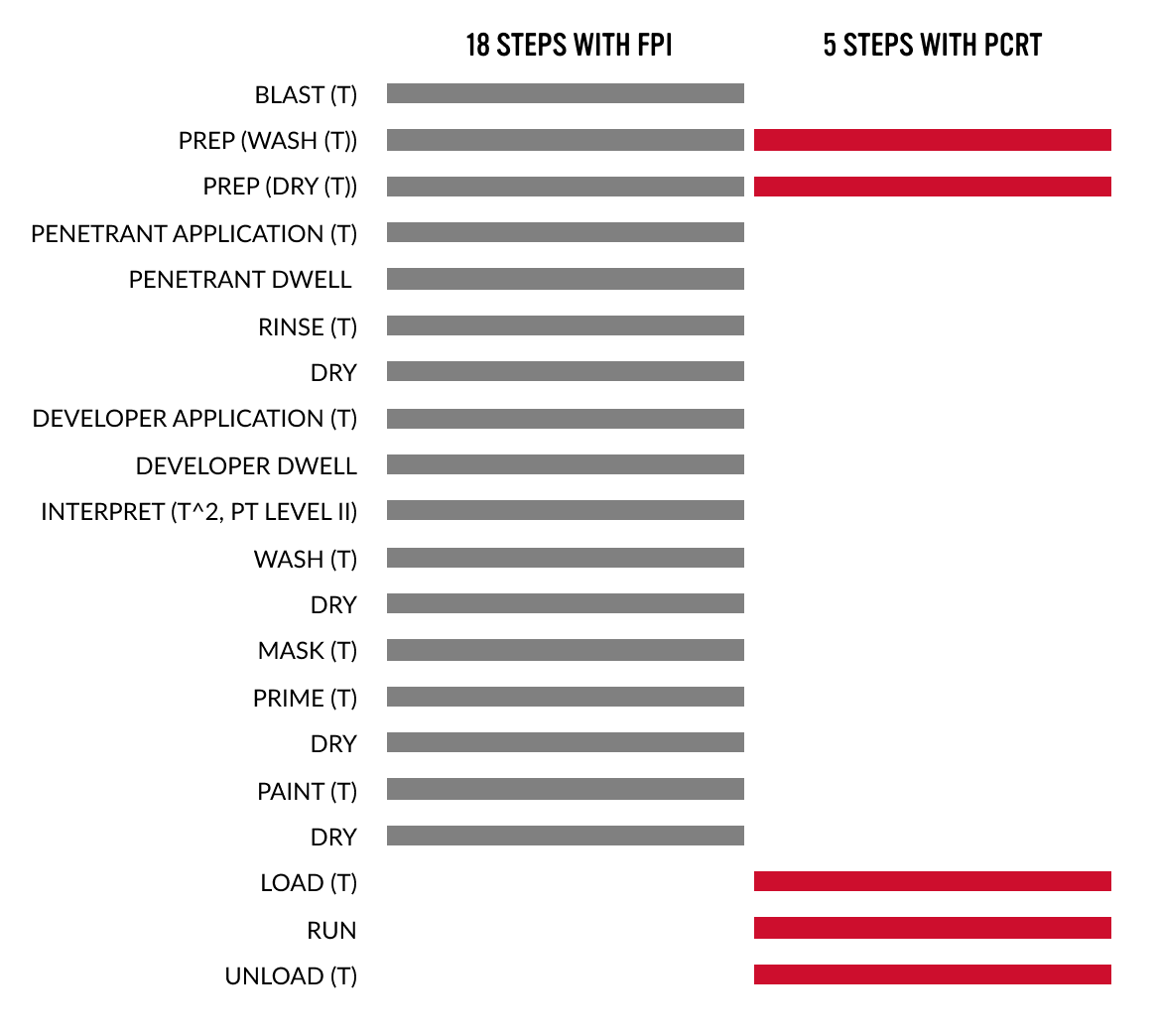
(T) indicates process steps that require operator involvement.
A DIFFERENT OPERATIONAL APPROACH
PCRT introduces a whole-body resonance-based inspection method authorized within OEM documentation and deployed in commercial wheel maintenance environments.
Rather than relying on surface penetrant processes, PCRT evaluates the structural condition of the wheel while it remains painted. The inspection requires hardware removal but does not require paint stripping or reapplication.
The system stimulates the wheel into its natural resonance modes. These resonance signatures are compared against validated reference datasets using statistical analysis to produce an objective pass/fail determination.
This approach does not replace the role of certified personnel. Instead, it allows their expertise to be applied where it is most needed, while routine processing steps are streamlined.
DELIVERED THROUGH A SCALABLE SERVICE MODEL
PCRT is implemented through Vibrant’s service model, structured to align inspection cost with operational volume.
Under this model:
- No capital equipment purchase is required
- Inspection costs scale with monthly throughput
- Software, configuration management updates and system support are managed by Vibrant together with the wheel OEM
- Systems are installed on-site to support production-scale operations; lower-volume programs may utilize remote inspection services.
For many operators, this structure removes the financial barrier typically associated with adopting new inspection systems and allows evaluation based on operational performance rather than capital budgeting cycles.

INTEGRATION WITHIN EXISTING WORKFLOW
Within the shop environment, the process is straightforward.
The disassembled, painted and roughly cleaned wheel is placed into the PCRT system. The automated inspection is completed in minutes, producing a clear pass/fail result.
The process eliminates:
- Blasting media use
- Paint stripping and repaint cycles
- Penetrant application and removal
If a wheel is identified by PCRT for further evaluation, additional inspection may be performed in accordance with established shop procedures prior to return-to-service decisions.
This allows PCRT to integrate into existing quality frameworks without disrupting compliance structures.
OPERATIONAL IMPACT CONSIDERATIONS
Each wheel shop environment is different. When evaluating PCRT, operators typically begin with a structured review of their current inspection workflow, including:
Average inspection cycle time per wheel
Cost associated with paint removal and reapplication
Certified NDT technician utilization rates
Hazardous material handling and disposal requirements
Facility bottlenecks and space constraints
Monthly overhaul volume and throughput targets
These inputs define the current operational baseline. For many shops, this baseline directly determines inspection cost per wheel.
By eliminating paint removal and reapplication steps, reducing material handling, and automating pass/fail determination, PCRT can materially influence that baseline.
Across commercial deployments, operators report:
Reduced Overall Inspection Flow Time
Eliminating multiple process stages shortens the total inspection cycle and improves shop throughput.
Improved Allocation of Certified Labor
Highly trained NDT personnel can focus on concentrated or required inspections rather than routine processing steps.
Lower Environmental Handling Requirements
Reduced use of penetrants, blasting media, and paint decreases hazardous material management and associated environmental impact.
Strong Yield Performance in Production
In certain environments, a substantial portion of wheels complete PCRT without requiring paint removal or additional preparation steps.
Bottleneck Relief Without Facility Expansion
Automated testing and compact system footprint support higher throughput within existing space constraints.
Scalable Cost Structure
The pay-per-test service model aligns inspection cost directly with shop activity, avoiding capital equipment investment.
For many operators, PCRT is not simply a change in inspection method. It is a workflow optimization decision supported by production-scale data that delivers measurable cost reduction per wheel.
DEMONSTRATED IN COMMERCIAL WHEEL MRO
Vibrant and Collins Aerospace were recognized with the A4A & SAE 18th Annual Nondestructive Testing Innovation Award for implementing resonance inspection in commercial aircraft wheel and brake MRO. Since deployment:
More than 120,000+ wheel halves have been inspected using PCRT
Collins MRO shops utilize PCRT for more than 80% of their active wheel MRO volume.
The inspection is authorized within OEM documentation
The system operates at production scale within commercial MRO environments.
Configurations exist for approved part numbers, with additional configurations available.
EVALUATING FIT FOR YOUR OPERATION
PCRT is particularly suited for facilities performing substantial monthly wheel overhaul volumes and seeking to:
- Implement OEM-authorized inspection
- Improve throughput without expanding facility footprint
- Reduce environmental material handling requirements
- Preserve certified technician capacity
- Avoid capital equipment investment
Each evaluation should be based on shop-specific data and workflow analysis.
Vibrant works directly with operators to assess potential operational impact within their environment.

BEYOND MRO APPLICATIONS
PCRT is also used in manufacturing settings to detect process variation, supplier inconsistencies, and early-stage structural defects. Birth Certificate data provides traceable baseline information that supports lifecycle monitoring and long-term asset management.
FREQUENTLY ASKED QUESTIONS
Is PCRT authorized by OEMs?
Yes. PCRT is authorized within OEM documentation and actively deployed in commercial wheel MRO environments.
Do wheels require paint removal prior to inspection?
No. PCRT evaluates the wheel while it remains painted.
How long does inspection take?
Inspection time varies by configuration and shop environment but is typically measured in minutes per wheel.
Is capital equipment required?
No. PCRT operates under a pay-per-test service model.
What occurs if a wheel is identified for further evaluation?
Additional inspection may be performed in accordance with established shop procedures prior to return-to-service decisions.
Is PCRT aligned with applicable ASTM standards?
PCRT deployment aligns with applicable ASTM standards and OEM documentation for approved components.
Does operation require NAS410- or ASNT-certified personnel?
System operation does not require subjective interpretation. Facilities continue to maintain certified personnel in accordance with their quality requirements.

EVALUATE PCRT WITHOUT CAPITAL COMMITMENT
Because PCRT operates under a pay-per-test service model, implementation begins with a workflow review — not a capital purchase decision.
Let’s assess potential impact based on your shop’s actual volume and configuration.
